TMJ Guide
ADHD and Decision Fatigue: Why It Hits Harder and How to Manage It (2026)
ADHD and decision fatigue: why it hits harder, the science behind it, and practical systems to reduce daily decisions. Expert strategies from an ADHD psychologist.
By Dr. Rachel H., ADHD Coach & Psychologist · Published 2026-03-10 · Updated 2026-03-10
Disclosure: ADHD Productivity Tips may earn commissions from qualifying purchases via Amazon Associates and other affiliate programs. This does not influence our recommendations — we only recommend products we have evaluated for ADHD-specific use cases.
By Dr. Rachel H., ADHD Coach & Psychologist · Last updated March 2026
Decision fatigue — the progressive decline in decision-making quality after a long series of choices — affects everyone, but it hits ADHD brains disproportionately harder. With lower baseline executive function, impaired working memory, and difficulty filtering low-stakes choices from high-stakes ones, ADHD adults burn through their daily decision-making capacity before lunch. This guide explains why it happens and provides six practical systems for reducing the number of decisions you make each day so you can protect your cognitive resources for what actually matters.
 When every small choice feels equally urgent, decision fatigue sets in fast — especially with ADHD.
What Is Decision Fatigue?
Decision fatigue is the measurable decline in the quality of decisions made after a long session of decision-making. It was first identified in research by social psychologist Roy Baumeister, who demonstrated that willpower and decision-making draw from the same finite pool of mental energy — and that pool depletes with use.
The concept is straightforward: every decision you make, from what to eat for breakfast to which email to respond to first to whether to accept a meeting invitation, consumes a small amount of executive function. After enough decisions, the quality of your choices degrades. You start defaulting to the easiest option, avoiding decisions entirely, or making impulsive choices you later regret.
How Decision Fatigue Manifests
For most people, decision fatigue shows up in predictable ways:
- Decision avoidance: Putting off choices, letting emails pile up, saying "I'll deal with it later" repeatedly
- Impulsive decisions: Choosing the fastest option rather than the best option — ordering takeout instead of cooking, buying the first search result instead of comparing
- Decision paralysis: Staring at options without being able to commit to any of them, cycling between alternatives
- Emotional reactivity: Snapping at people, feeling overwhelmed by questions that would normally be easy to answer
- Default to status quo: Choosing "whatever we did last time" regardless of whether it is still the best choice
The average adult makes an estimated 35,000 decisions per day (Sahakian & Labuzetta, 2013). Most of these are micro-decisions that your brain handles automatically — which foot to step with, how hard to grip a cup, when to blink. But hundreds are conscious choices that require real cognitive effort. For neurotypical adults, this is manageable. For ADHD adults, it is a daily crisis.
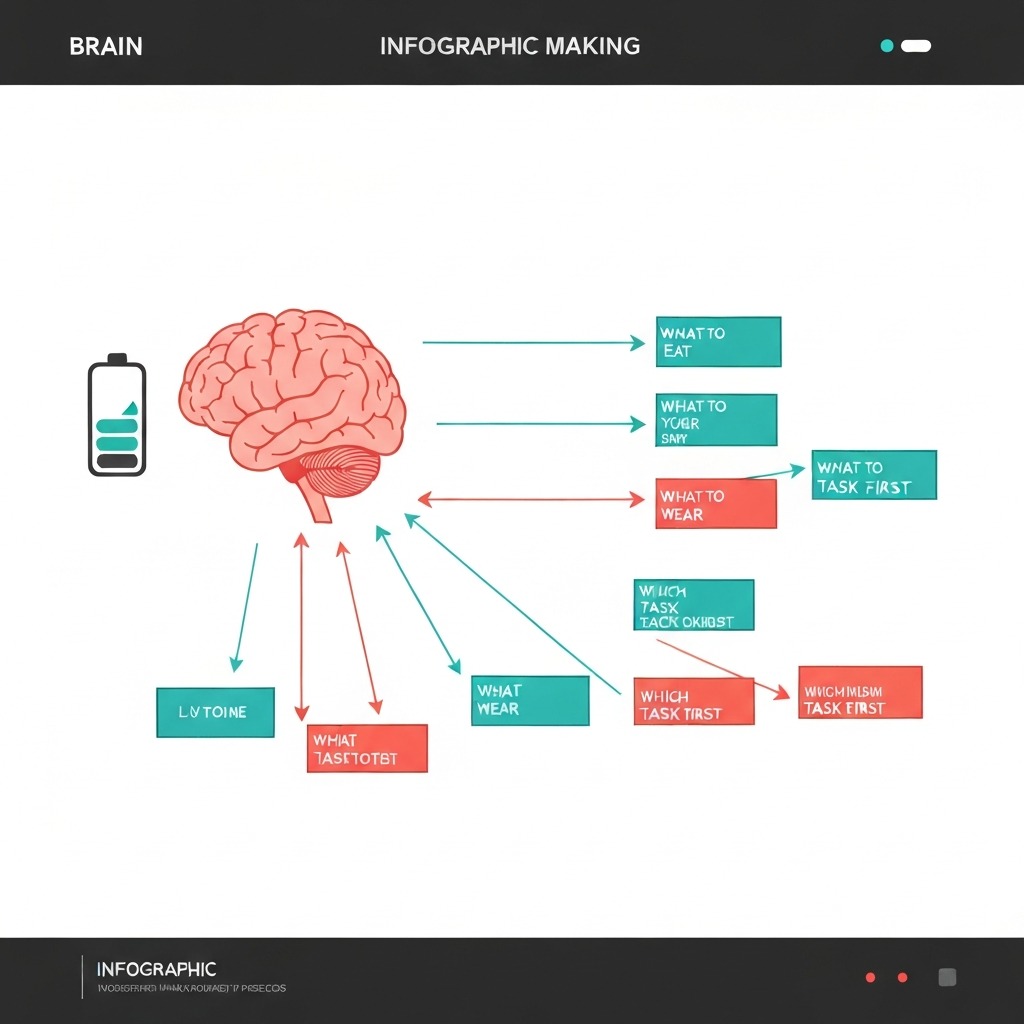 The ADHD brain starts each day with less executive function fuel — and every decision drains it faster.
Why Decision Fatigue Hits ADHD Brains Harder
If you have ADHD and you feel completely drained by 2 PM even though you "didn't really do anything," decision fatigue is almost certainly a major factor. Here is why your brain is more vulnerable:
1. Lower Baseline Executive Function
Executive function is the cognitive control system that manages planning, prioritizing, evaluating options, and committing to a course of action. In ADHD, executive function is impaired at baseline — not absent, but operating with less capacity and less consistency than neurotypical brains.
Think of it this way: if executive function is a battery, neurotypical adults start the day at 100% charge. ADHD adults might start at 60-70%. Both batteries drain at similar rates with each decision, but the ADHD battery hits critical levels much sooner.
This is not about intelligence, effort, or character. It is a neurological difference in how the prefrontal cortex regulates dopamine and norepinephrine — the neurotransmitters that power executive function. You cannot willpower your way to a bigger battery.
2. Impaired Working Memory
Working memory — the ability to hold and manipulate information in your mind simultaneously — is one of the most consistently impaired cognitive functions in ADHD. When you are making a decision, working memory is what allows you to hold multiple options in mind, compare their pros and cons, and evaluate trade-offs.
For ADHD adults, this process is more cognitively expensive. Where a neurotypical person might effortlessly compare three restaurant options, an ADHD brain struggles to hold all three in working memory simultaneously. The result: each decision costs more cognitive energy, and your daily decision budget runs out faster.
3. Difficulty Filtering Decision Importance
Neurotypical brains have an efficient triage system for decisions. "What socks to wear" gets routed to automatic processing and resolved in seconds. "Whether to accept a new job offer" gets routed to deliberate processing and allocated significant cognitive resources.
ADHD brains struggle with this triage. Low-stakes decisions — what to have for lunch, which route to drive, whether to respond to a text now or later — can consume as much cognitive effort as high-stakes decisions. Your brain treats every choice as if it requires the same level of deliberation.
This is why you can spend 30 minutes agonizing over which notebook to buy on Amazon but make a $5,000 financial decision in 10 seconds. The triage system is unreliable, and the result is that mundane decisions consume executive function that should have been reserved for what matters.
4. The Procrastination Amplifier
Decision fatigue and ADHD procrastination feed each other in a vicious cycle. When decision fatigue sets in, your brain avoids making any decision at all — which means tasks pile up, creating a larger backlog of decisions that need to be made later. When you finally face that backlog, the sheer volume of deferred decisions triggers overwhelm, which triggers more avoidance.
This cycle is why ADHD adults often describe end-of-day paralysis: the decisions that were deferred all morning have accumulated into an impossible wall of choices, and your already-depleted executive function cannot handle any of them.
The Hidden Cost: How Many Decisions Do You Actually Make?
Most ADHD adults dramatically underestimate how many conscious decisions they make in a typical day. Here is a realistic accounting of a typical morning:
Before leaving the house (6:30 AM – 8:00 AM):
- What time to get up (snooze or not?)
- What to wear (top, bottom, shoes, accessories)
- What to eat for breakfast (and whether to eat at all)
- Whether to make coffee at home or buy it
- Which tasks to do before leaving (shower first? pack lunch? check email?)
- What to pack in your bag
- Which route to take
- Whether to listen to music, a podcast, or nothing in the car
That is 15-20 conscious decisions before your workday even begins. By the time a neurotypical person is barely thinking about their day, an ADHD adult has already burned through a significant portion of their decision-making capacity — because each of those 15-20 decisions required more cognitive effort than it would for a neurotypical brain.
The solution is not to "try harder" at making decisions. The solution is to make fewer of them.
 A pre-decided morning station eliminates 10+ daily decisions before they even arise.
System 1: Automate Your Morning Routine
Your morning routine is the highest-leverage target for decision elimination because it happens every day and sets the tone for your cognitive capacity throughout the rest of the day.
The Pre-Decision Method
Instead of making decisions in the morning, make them the night before — or better yet, make them once and never revisit them.
Step 1: Audit your morning decisions. For three days, write down every choice you make between waking up and starting work. Most people find 15-25 decisions.
Step 2: Eliminate or pre-decide each one. Go through your list and for each decision, determine:
- Can this be eliminated entirely? (e.g., switching to the same breakfast every weekday)
- Can this be decided once and repeated? (e.g., always taking the same route to work)
- Can this be decided the night before? (e.g., laying out clothes, packing your bag)
Step 3: Create a physical setup. Designate a "launch pad" by your door with everything you need: keys, wallet, bag, pre-packed lunch. Lay out your clothes the night before in the same spot every night.
The "Same Thing Every Day" Approach
Many successful people with ADHD eat the same breakfast every weekday, wear variations of the same outfit, and follow the same morning sequence without variation. This is not boring — it is strategic. Every automated routine decision frees cognitive capacity for the decisions that actually need your attention later in the day.
If you already use an ADHD morning routine, layering decision pre-commitment on top of your existing structure will significantly reduce the cognitive load of your first hour.
 A capsule wardrobe turns "what should I wear?" from a 15-minute decision into a 30-second grab.
System 2: The Capsule Wardrobe Approach
Clothing decisions are a surprisingly large source of decision fatigue for ADHD adults. The combination of too many options, sensory preferences (many ADHD adults have strong texture and fit preferences), and the daily repetition makes wardrobe decisions a consistent cognitive drain.
Building an ADHD-Friendly Capsule Wardrobe
A capsule wardrobe is a small collection of versatile pieces that all work together. The goal is to make it nearly impossible to pick a bad combination.
The Rules:
- Limit to 30-35 pieces (excluding underwear, sleepwear, workout clothes, and special occasion outfits)
- Choose a neutral base palette — black, navy, gray, or white — so everything matches everything
- Add 2-3 accent colors that all work with your base
- Prioritize comfort — if a piece is uncomfortable or requires specific undergarments or accessories, remove it
- Buy duplicates of what works — if you find a perfect-fitting t-shirt, buy five
Why This Works for ADHD
A capsule wardrobe removes the paradox of choice from your morning. Instead of scanning a full closet and evaluating dozens of combinations, you reach in and grab any combination that works. The cognitive cost drops from a 5-15 minute deliberation to a 30-second selection.
The time you save is valuable, but the executive function you preserve is even more valuable. Those cognitive resources are now available for your first real decision of the workday.
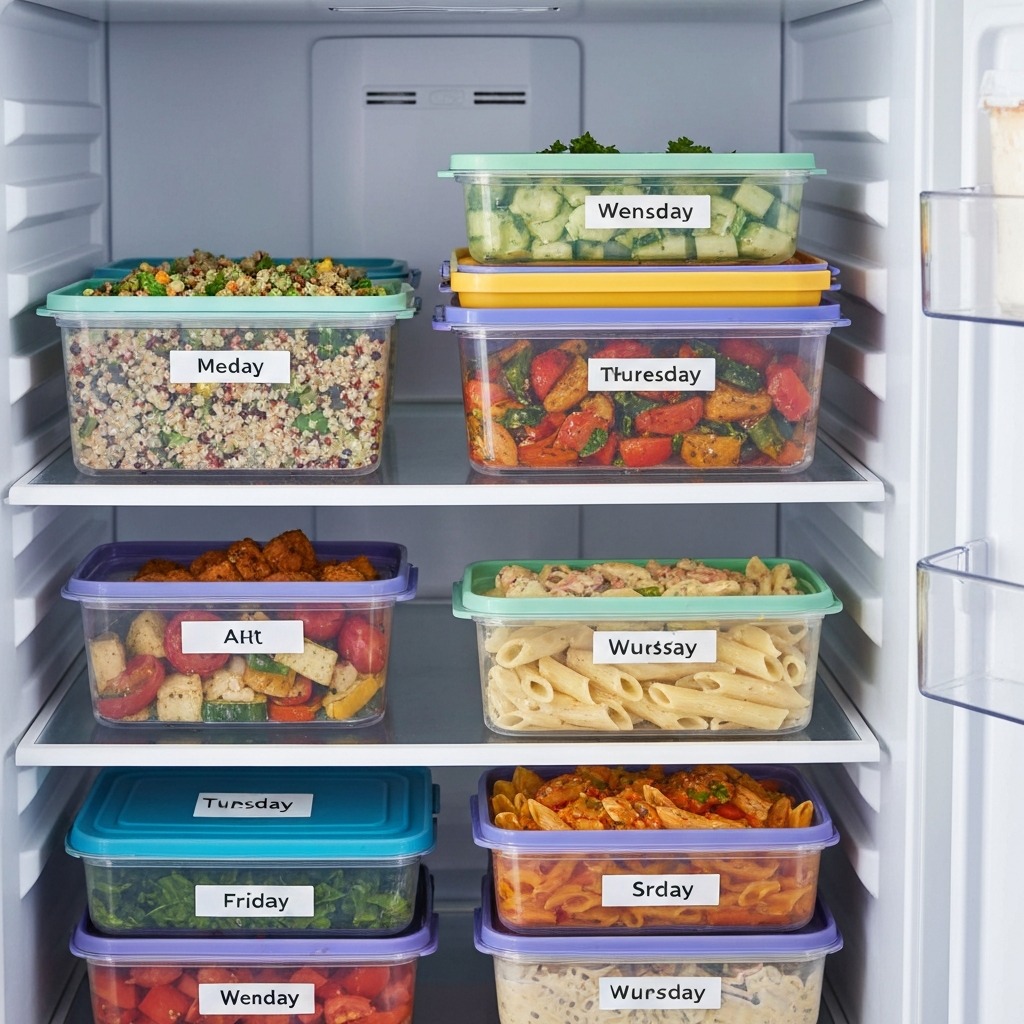 Weekly meal prep eliminates 21+ food decisions per week — one of the highest-ROI changes for ADHD decision fatigue.
System 3: Meal Prep and Food Decision Elimination
Food decisions are a triple threat for ADHD decision fatigue:
- They happen 3-5 times per day (breakfast, lunch, dinner, plus snacks)
- Each decision has multiple sub-decisions (what to eat, what ingredients to use, how to prepare it, how long it will take)
- They intersect with executive function at its lowest — the "what's for dinner?" question hits when you are already cognitively depleted from a full day of work decisions
The ADHD Meal Prep System
Weekly Batch Cooking (Sunday, 2-3 hours):
- Pick 3 proteins, 3 carbs, 3 vegetables
- Cook everything in bulk
- Portion into labeled containers for the week
- Store grab-and-go breakfasts (overnight oats, pre-made smoothie bags, hard-boiled eggs)
The "Rotation Menu" Alternative: If full meal prep feels overwhelming, create a simple rotation:
- Monday: pasta dish
- Tuesday: stir fry
- Wednesday: sheet pan meal
- Thursday: slow cooker / instant pot
- Friday: takeout (planned, not reactive)
The rotation menu eliminates the "what should we eat?" decision entirely. You always know what is for dinner because it is determined by the day of the week.
Grocery Automation
Pair meal prep with automated grocery ordering. Most grocery delivery services allow you to save a recurring order. Set up a standing weekly order based on your rotation menu, and adjust only when needed. This eliminates the grocery decision cascade: what to buy, which brand, how much, whether you need it.
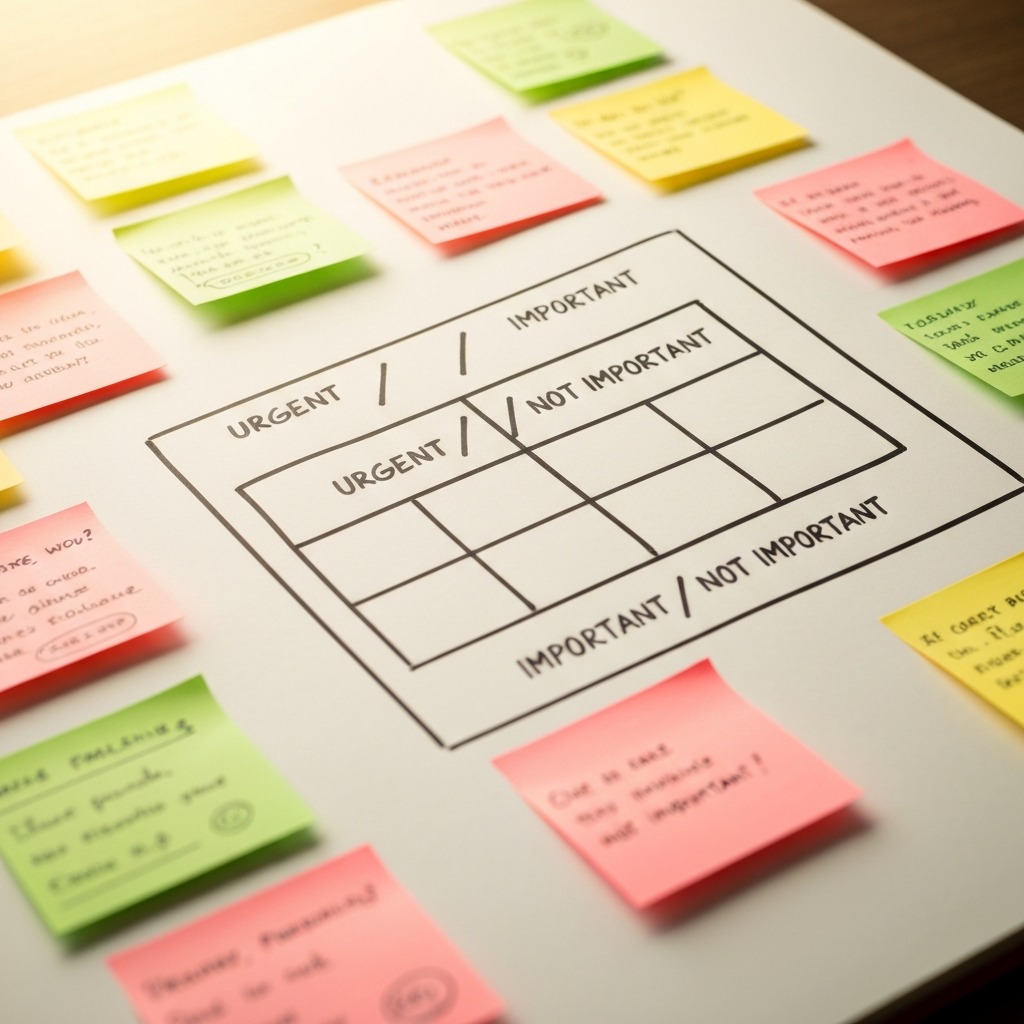 Decision frameworks replace deliberation with a simple, repeatable process — exactly what the ADHD brain needs.
System 4: Decision Frameworks That Replace Deliberation
When you cannot eliminate a decision, you can reduce its cognitive cost by using a framework — a pre-determined set of rules that converts open-ended deliberation into a simple, mechanical process.
The 2-Minute Rule
If a decision or task will take less than 2 minutes to complete, do it immediately. Do not evaluate it, prioritize it, add it to a list, or think about when to do it. Just do it now.
This rule eliminates hundreds of micro-decisions per week: whether to respond to that email, whether to file that document, whether to put that dish in the dishwasher. The decision is made by the rule, not by you.
The Eisenhower Matrix
For larger decisions about how to spend your time, the Eisenhower Matrix sorts every task into one of four quadrants:
- Urgent + Important: Do it now
- Important + Not Urgent: Schedule it for a specific time
- Urgent + Not Important: Delegate or batch it
- Not Urgent + Not Important: Eliminate it
The power of this framework for ADHD is that it replaces the subjective, energy-intensive question of "what should I work on?" with a mechanical sorting process. You are not deciding what to do — you are categorizing, which is a simpler cognitive operation.
The "Good Enough" Threshold
ADHD perfectionism and decision fatigue create a devastating combination: you cannot choose because you are searching for the perfect option, but the perfect option does not exist, so you never choose.
The "Good Enough" threshold works like this: before you start evaluating options, define your minimum acceptable criteria. The first option that meets all criteria is your choice. Stop looking.
For example, buying a new laptop:
- Budget: under $1,200
- RAM: at least 16GB
- Weight: under 4 pounds
- Battery: at least 10 hours
The first laptop that meets all four criteria is the one you buy. You do not compare it to alternatives, read 15 more reviews, or open 30 browser tabs. The decision is made.
The "If-Then" Pre-Commitment
Create rules that make future decisions automatic:
- If someone asks me to volunteer, then I say "let me check my calendar and get back to you by tomorrow"
- If I have not started a task by 2 PM, then I use the Pomodoro Technique to start with just 25 minutes
- If I am debating between two equally good options for more than 5 minutes, then I flip a coin and commit
These pre-commitments transform open-ended decisions into automatic responses, eliminating the cognitive cost entirely.
System 5: Protect Your Peak Decision-Making Window
Not all hours are equal for ADHD decision-making. Executive function fluctuates throughout the day, and understanding your personal rhythm allows you to strategically match decision complexity to cognitive capacity.
Identifying Your Peak Window
For medicated ADHD adults, the peak decision-making window typically begins 30-60 minutes after medication takes effect and lasts 2-4 hours. For unmedicated adults, peak cognitive function often occurs in the first 2-3 hours after waking, before the accumulated decisions of the day start depleting executive function.
Track your pattern: For one week, rate your decision-making quality on a 1-5 scale every two hours. Note when you feel sharp, decisive, and confident versus when you feel foggy, indecisive, and overwhelmed. Most people find a clear 2-4 hour window where decisions feel easier.
The Decision Scheduling Strategy
Once you know your peak window, restructure your day:
Peak window (high executive function):
- Complex work decisions
- Financial decisions
- Difficult conversations
- Creative problem-solving
- Planning and strategic thinking
Off-peak hours (lower executive function):
- Routine tasks that do not require decisions (data entry, filing, cleaning)
- Pre-decided tasks from your planner or to-do list
- Tasks with clear instructions and no ambiguity
- Physical tasks and movement
Decision-free zones:
- Block 1-2 hours per day as "no new decisions" time where you only execute pre-decided tasks
- Use your ADHD planner to pre-decide what these hours are used for
This approach does not give you more executive function — it ensures you spend what you have on the decisions that matter most.
 The right tools offload decisions from your working memory to external systems — a game-changer for ADHD.
System 6: External Systems and Tools That Decide for You
The most effective ADHD decision fatigue strategy is to move decisions out of your head and into external systems that make the choice for you — or at least narrow the options to a manageable few.
Why External Systems Work for ADHD
ADHD working memory is unreliable. When you try to hold decisions, priorities, deadlines, and options in your head simultaneously, the system overloads. External systems — planners, apps, checklists, and frameworks — serve as a "second brain" that holds information so your working memory does not have to.
This is not a crutch. It is a prosthetic for a documented neurological limitation. You would not ask someone with impaired vision to just "try harder to see." External decision support systems serve the same function as corrective lenses — they compensate for a specific deficit so the rest of your cognitive system can function at its best.
Building Your External Decision System
Layer 1: Capture (reduce the "what am I forgetting?" decisions)
- Use a single inbox for all incoming tasks, ideas, and commitments
- The moment something enters your awareness, capture it externally
- This eliminates the recurring decision of "should I deal with this now or remember it for later?"
Layer 2: Organize (reduce the "what should I do next?" decisions)
- Weekly review: sort your inbox into categories and priorities
- Daily planning: pre-decide your top 3 tasks for tomorrow before the day ends
- Time blocking: assign tasks to specific time slots so you never have to decide "what now?"
Layer 3: Automate (reduce recurring routine decisions)
- Recurring tasks on autopilot (bill pay, grocery orders, medication reminders)
- Templates for common decisions (email responses, meeting agendas, weekly routines)
- Habit tracking to automate routine behaviors until they become automatic
Recommended Decision-Reducing Tools for ADHD
Todoist Premium
Type: Task Manager with Auto-Prioritization
ADHD Benefit: Smart scheduling and priority suggestions eliminate "what should I do next?" decisions
Price: Free / $4 mo premium
Check Price on Amazon →
Clever Fox Planner Pro
Type: Structured Paper Planner
ADHD Benefit: Built-in priority sections and time blocks pre-decide your day structure
Price: ~$25
Check Price on Amazon →
Time Timer MOD
Type: Visual Countdown Timer
ADHD Benefit: Sets decision deadlines — when the timer runs out, you commit to whatever you have
Price: ~$37
Check Price on Amazon →
PrepNaturals Glass Meal Prep Containers (5-pack)
Type: Meal Prep Storage
ADHD Benefit: Pre-portioned, visible food containers eliminate daily "what should I eat?" decisions
Price: ~$28
Check Price on Amazon →
GRANNY SAYS Closet Organizer System
Type: Wardrobe Organization
ADHD Benefit: Compartmentalized sections make capsule wardrobe visible and grab-and-go simple
Price: ~$24
Check Price on Amazon →Building Your Personal Decision Fatigue Defense Plan
You do not need to implement all six systems at once. In fact, trying to overhaul everything simultaneously would itself be an overwhelming decision — which defeats the entire purpose.
The 3-Week Implementation Approach
Week 1: Audit and Automate Morning
- Track all decisions you make in a typical day (just write them down — awareness alone is powerful)
- Implement the morning pre-decision system: lay out clothes, prep breakfast, pack bag the night before
- Set up a "launch pad" by your door
Week 2: Add Food and Wardrobe Systems
- Create a 5-day meal rotation or do your first weekly meal prep
- Audit your closet and begin building a capsule wardrobe (start by removing items you never wear)
- Set up a recurring grocery order for your rotation meals
Week 3: Install Decision Frameworks
- Start using the 2-Minute Rule for small tasks
- Print the Eisenhower Matrix and use it for your daily planning session
- Create 3-5 "if-then" rules for your most common recurring decisions
- Identify and protect your peak decision-making window
Maintaining the System
The enemy of any ADHD system is drift. These strategies work brilliantly for the first 2-3 weeks, and then the novelty fades and old patterns creep back.
Build in a weekly reset — a 15-minute Sunday session where you:
- Prep your meals or confirm your meal rotation
- Lay out your Monday morning setup
- Review your if-then rules
- Pre-decide your top priorities for the week ahead
This weekly maintenance decision costs one small investment of executive function to save hundreds of micro-decisions throughout the week. It is the highest-ROI 15 minutes in your week.
Frequently Asked Questions
Is decision fatigue a real medical condition?
Decision fatigue is not a clinical diagnosis, but it is a well-documented cognitive phenomenon supported by decades of research in psychology and behavioral economics. For ADHD adults, it interacts with executive function deficits to create measurable impairments in daily functioning. While not a "condition" itself, it is a reliable consequence of how the human brain — and especially the ADHD brain — processes choices.
Can ADHD medication help with decision fatigue?
Yes, indirectly. Stimulant medications (methylphenidate, amphetamine salts) improve executive function, working memory, and impulse regulation — all of which are involved in decision-making. Many ADHD adults report that decisions feel easier and less draining when medicated. However, medication does not eliminate decision fatigue; it raises the baseline capacity. The environmental and behavioral strategies in this guide remain essential even with medication.
How do I know if I am experiencing decision fatigue vs. regular ADHD overwhelm?
Decision fatigue has a specific pattern: it worsens progressively throughout the day and is directly linked to the number of decisions you have already made. If you feel sharp and decisive in the morning but paralyzed by afternoon, decision fatigue is likely the primary driver. Regular ADHD overwhelm can occur at any time and is often triggered by task complexity, emotional dysregulation, or sensory overload rather than cumulative decision volume.
What if my job requires constant decision-making?
If your role involves continuous decisions (management, medicine, customer service, teaching), decision fatigue management becomes even more critical. The strategy shifts to protecting off-work decisions: automate every personal decision possible (meals, clothing, routines) so that your full decision-making capacity is available for professional demands. Also build in decision-free recovery breaks during the workday — even 10-15 minutes of no-decision activity (walking, breathing, stretching) can partially restore decision-making capacity.
Can decision fatigue affect relationships?
Absolutely. Decision fatigue is a significant contributor to relationship friction for ADHD adults. The classic "I don't know, what do YOU want to do?" pattern — where one partner cannot engage with dinner, weekend, or household decisions — is often decision fatigue rather than apathy. Sharing this framework with your partner can transform these moments from personal frustrations into shared problem-solving: "I am decision-fatigued right now — can you make this call, or can we default to our Tuesday rotation?"
Sources and Methodology
This article draws on the following research and clinical sources:
-
Baumeister, R.F., et al. (1998). "Ego depletion: Is the active self a limited resource?" Journal of Personality and Social Psychology, 74(5), 1252-1265. Foundational research on willpower depletion and decision fatigue.
-
Barkley, R.A. (2012). Executive Functions: What They Are, How They Work, and Why They Evolved. Guilford Press. Comprehensive framework for understanding ADHD executive function deficits and their impact on daily decision-making.
-
Sahakian, B.J., & Labuzetta, J.N. (2013). Bad Moves: How Decision Making Goes Wrong, and the Ethics of Smart Drugs. Oxford University Press. Research on decision volume and cognitive depletion.
-
Vohs, K.D., et al. (2008). "Making choices impairs subsequent self-control: A limited-resource account of decision making, self-regulation, and active initiative." Journal of Personality and Social Psychology, 94(5), 883-898. Evidence that decision-making depletes the same resources as self-regulation.
-
Danziger, S., Levav, J., & Avnaim-Pesso, L. (2011). "Extraneous factors in judicial decisions." Proceedings of the National Academy of Sciences, 108(17), 6889-6892. Landmark study showing decision fatigue in real-world professional settings.
-
Brown, T.E. (2013). A New Understanding of ADHD in Children and Adults: Executive Function Impairments. Routledge. Research connecting ADHD executive function impairments to decision-making capacity.
-
Schwartz, B. (2004). The Paradox of Choice: Why More Is Less. Ecco Press. Research on how excessive options impair decision quality — particularly relevant for ADHD adults who struggle to filter options.
Methodology: Recommendations in this article are based on published clinical research on ADHD executive function, behavioral psychology research on decision fatigue, and practical systems validated through clinical ADHD coaching. Product recommendations are based on functional utility for ADHD-specific decision reduction, not general consumer reviews.
About the Author
Dr. Rachel H. is a clinical psychologist and ADHD coach specializing in executive function strategies for adults with ADHD. With over 12 years of clinical experience, she focuses on practical, evidence-based systems that work with the ADHD brain rather than against it. Her approach emphasizes environmental design and behavioral frameworks over willpower-dependent strategies.
Looking for more ADHD productivity strategies? Explore our guides on the best planners for ADHD adults, ADHD and procrastination, and building an ADHD morning routine.
Walking Pad vs Treadmill
30-second comparison