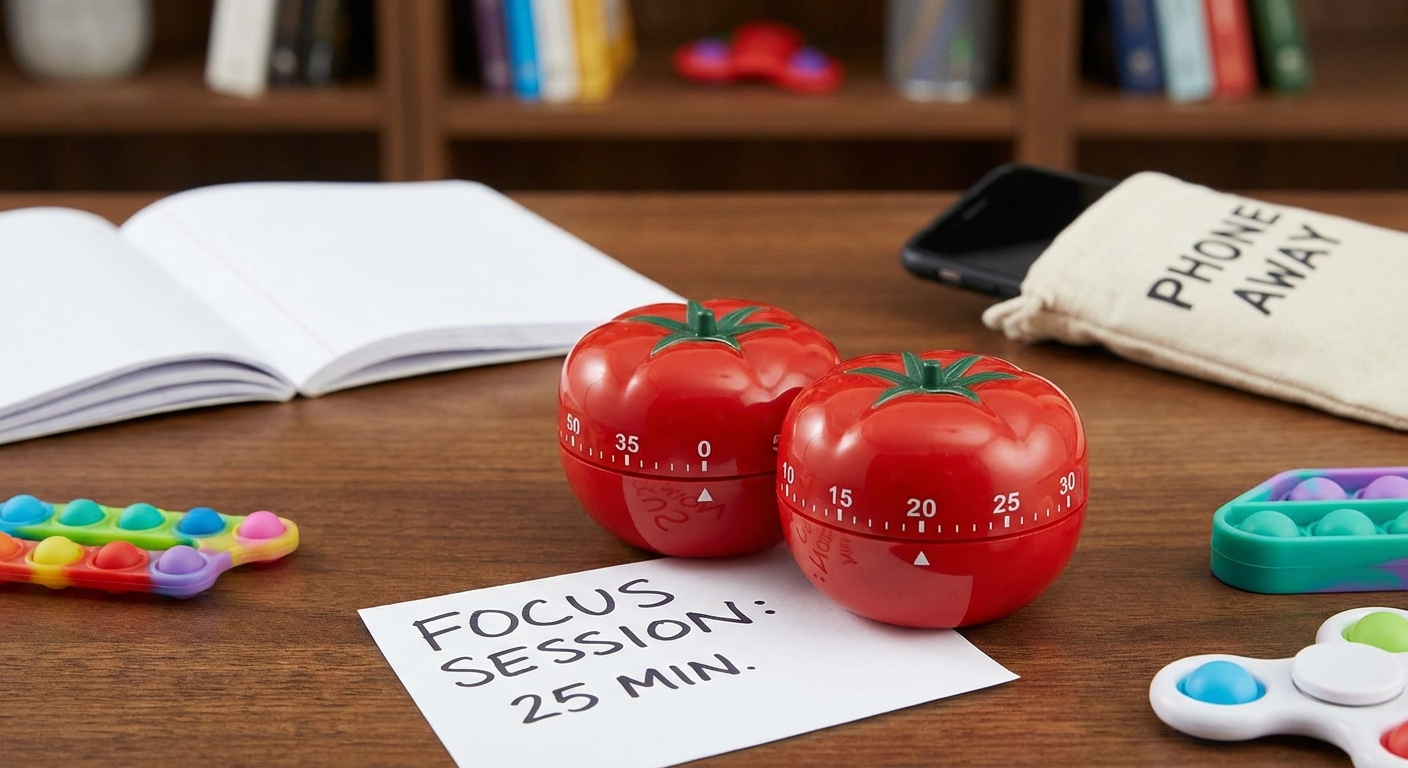
The Pomodoro Technique for ADHD: Does It Work?

Disclosure: ADHD Productivity Tips may earn commissions from qualifying purchases. This does not influence our recommendations.
By Dr. Marcus Webb, Clinical Psychologist & ADHD Coach · Last updated March 2026
The Pomodoro Technique works for ADHD — but not the way it was designed. The standard 25-minute intervals are too long for most ADHD adults, the mandatory break structure interrupts valuable hyperfocus states, and the transition back to work after breaks is a documented ADHD struggle. Modified Pomodoro with 15-minute intervals, flexible hyperfocus continuation, and structured re-entry rituals outperforms the standard method for ADHD.
 Pomodoro with ADHD: the core mechanism (artificial urgency) is right — the intervals need modification.
What is the Pomodoro Technique?
The Pomodoro Technique, developed by Francesco Cirillo in the late 1980s, structures work into defined time blocks:
- Choose a task
- Set a timer for 25 minutes (one "Pomodoro")
- Work on the task until the timer rings
- Take a 5-minute break
- Repeat four times, then take a 25-30 minute long break
The technique works by:
- Creating artificial urgency (the timer creates pressure that helps with initiation)
- Dividing overwhelming tasks into manageable chunks
- Building in regular recovery periods to prevent burnout
- Providing a simple external structure to replace internal regulation
For the neurotypical brain, this works well. For the ADHD brain, the mechanism is right but the implementation needs adjustment.
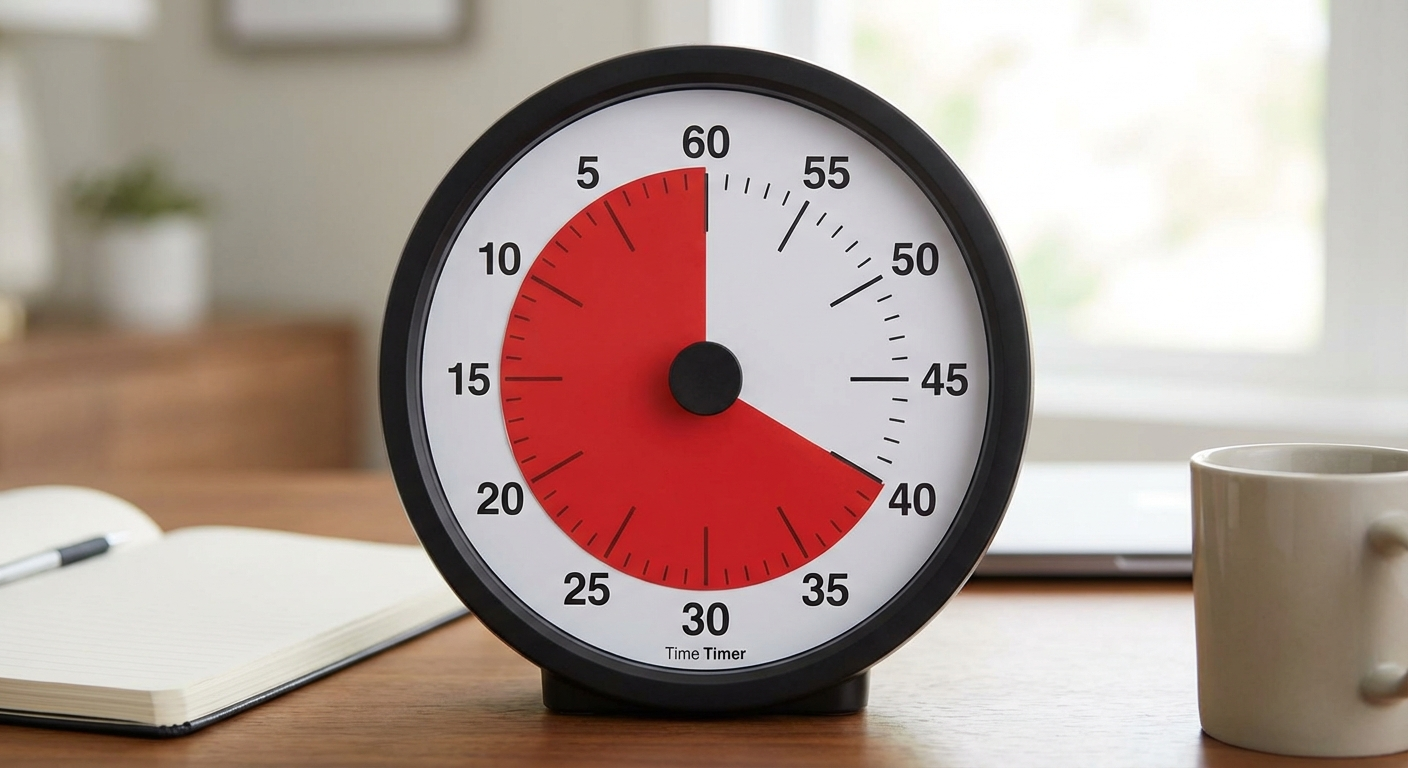 The Time Timer provides visual time awareness — critical for ADHD time blindness.
Why Pomodoro Appeals to ADHD Brains
The Pomodoro Technique addresses core ADHD challenges:
Artificial Urgency
ADHD brains activate primarily for interesting, urgent, or challenging tasks. A countdown timer creates manufactured urgency — the psychological equivalent of a deadline. "I only need to focus for 25 more minutes" reduces activation resistance in a way that "I need to work on this project" does not.
External Time Structure
One of the most common ADHD complaints is time blindness — difficulty sensing how much time has passed or estimating how long tasks will take. Pomodoro externalizes time tracking, removing the need to self-monitor time passage.
Chunk Decomposition
Large tasks feel paralyzing to ADHD brains because the scope triggers overwhelm. Breaking work into 25-minute chunks creates entry points that are psychologically smaller than "complete this project."
Progress Visibility
Counting completed Pomodoros provides tangible evidence of work completion — immediate feedback that dopamine-deficient brains need but rarely get from intrinsic satisfaction alone.
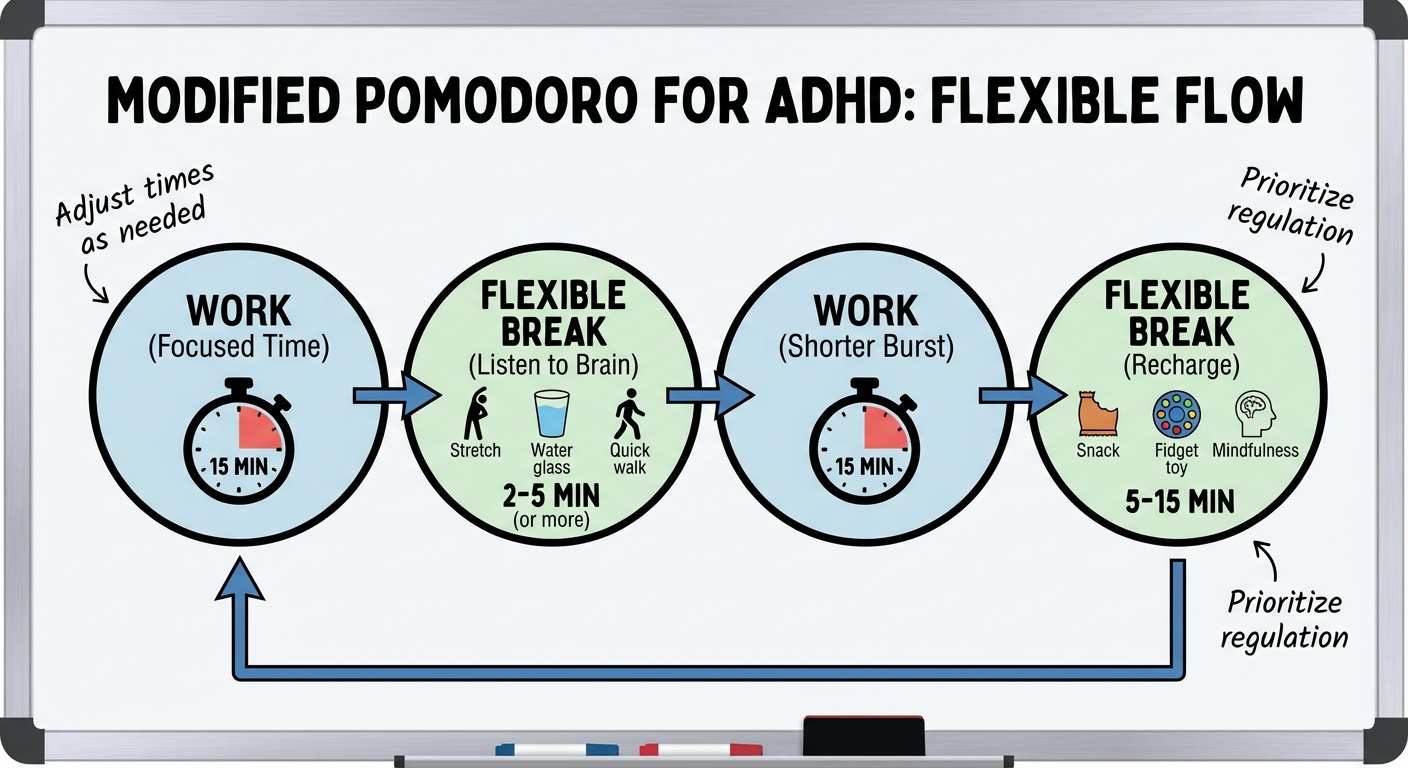 ADHD-modified Pomodoro: 15-minute intervals with flexible breaks work better than the standard 25/5 split.
Why Standard Pomodoro Fails ADHD
Despite its appeal, the standard Pomodoro method creates specific ADHD problems:
Problem 1: 25 Minutes Is Too Long for Initiation
For ADHD adults with significant task initiation difficulty, committing to 25 minutes feels overwhelming before starting. The prospect of 25 minutes of focused work on a boring task creates enough anxiety to trigger avoidance.
The cognitive math: "I'll just do this for 5 minutes" feels achievable. "I'll do 25 minutes" can feel like a mountain.
Problem 2: Breaks Interrupt Hyperfocus
ADHD brains are not consistently inattentive — they swing between inability to focus and hyperfocus, where concentration is intense and sustained. Hyperfocus states are among the most productive periods available to ADHD adults.
The rigid Pomodoro break structure interrupts these states precisely when productivity is highest. A mandatory break after 25 minutes of hyperfocus can shatter a flow state that took significant mental energy to achieve.
Problem 3: Transition Re-Entry Difficulty
ADHD brains struggle with transitions. The break is not just 5 minutes of rest — it is a context switch. Returning from a break requires re-initiating the task, which for ADHD brains can be nearly as difficult as the original start.
A standard Pomodoro session generates 3-4 of these re-entry moments per hour. Each one is a procrastination opportunity.
Problem 4: Break Activities Become Traps
ADHD brains are susceptible to hyperfocusing on break activities. Five minutes on your phone becomes 30 minutes. A "quick walk" becomes an extended distraction. Without structured break content, the break becomes the main problem.
The ADHD-Modified Pomodoro
These modifications make Pomodoro more effective for ADHD:
Modification 1: Shorten the Work Interval
| Version | Work Interval | Break | Best For |
|---|---|---|---|
| Standard Pomodoro | 25 min | 5 min | Neurotypical users |
| ADHD Standard | 20 min | 5 min | ADHD with moderate focus |
| ADHD Short | 15 min | 5 min | ADHD with severe initiation difficulty |
| ADHD Starter | 5-10 min | 3 min | First-time users, high-anxiety tasks |
| ADHD Flow | Flexible (15-60 min) | When losing focus | ADHD with frequent hyperfocus |
Rule: Start at your "minimum viable interval" — the shortest block you can commit to before the task. Increase gradually.
Modification 2: Allow Hyperfocus Override
Standard Pomodoro rule: stop at the timer.
ADHD rule: when genuinely in flow, continue. Only stop at a maximum session limit (90 minutes).
Set two timers:
- 15-minute "check-in" timer: at this point, ask "am I still focused or just avoiding stopping?"
- 90-minute "hard stop" timer: stop regardless, take a full break
Modification 3: Structure Breaks as Defined Activities
Instead of "take a 5-minute break" (unstructured):
Define break activities in advance:
- Walk to the kitchen and back (physical movement)
- 5 specific stretches (defined routine)
- 3 minutes of an audiobook or podcast (passive, non-screen)
- A specific short game (Wordle, not doom-scrolling)
Structure the break so the end is defined. "I'm taking a walking break, I'll return when I've walked to the mailbox and back" is better than "I'm taking 5 minutes off."
Modification 4: Structured Re-Entry Ritual
Before the first Pomodoro and after each break, use the same startup sequence:
- Open the same specific document or tool
- Read the last 2-3 lines you wrote
- Set the timer
- Write or do one small action before the timer starts
The ritual cues your brain that work is starting. Over time, it becomes automatic.
Optimal Timer Intervals by Task Type
Different tasks have different optimal intervals for ADHD:
| Task Type | ADHD Optimal Interval | Why |
|---|---|---|
| Writing (creative) | 25-40 min | Writing benefits from longer flow states |
| Writing (technical) | 15-20 min | More mentally taxing, needs more breaks |
| Reading | 15-20 min | Passive tasks lose ADHD attention faster |
| Coding / problem-solving | 20-30 min | Builds momentum; breaking disrupts problem state |
| Administrative tasks | 10-15 min | Boring tasks drain ADHD attention fastest |
| Learning / study | 20-25 min | Spaced repetition benefits from structured intervals |
| Email / communication | 15 min maximum | Open-ended checking becomes infinite scrolling |
Key principle: Make the interval feel slightly challenging but achievable. If you consistently fail to finish intervals, shorten them. If you consistently end intervals with more in the tank, lengthen them.
 Hyperfocus is a productivity asset for ADHD — the modified Pomodoro allows it to continue past the timer.
Hyperfocus and Pomodoro: When to Ignore the Timer
Hyperfocus is a feature of ADHD, not just a bug. When the ADHD brain locks onto an engaging task, it can sustain focus for hours at an intensity that neurotypical brains rarely achieve. This is valuable and should be protected.
Signs You're in Productive Hyperfocus (Continue Working)
- You forgot the timer was running
- You're producing output at an unusually fast rate
- Stopping feels physically difficult, not like relief
- The quality of what you're producing is high
Signs You're in Unproductive Rabbit Holes (Take the Break)
- You've been reading related articles instead of working
- You can't easily summarize what you just did for 25 minutes
- You've switched tasks multiple times within the interval
- You're refreshing communication apps "just to check"
The modified rule: Trust the hyperfocus when it's genuinely productive. Use the timer as a minimum, not a maximum. But if you're not sure, take the break.
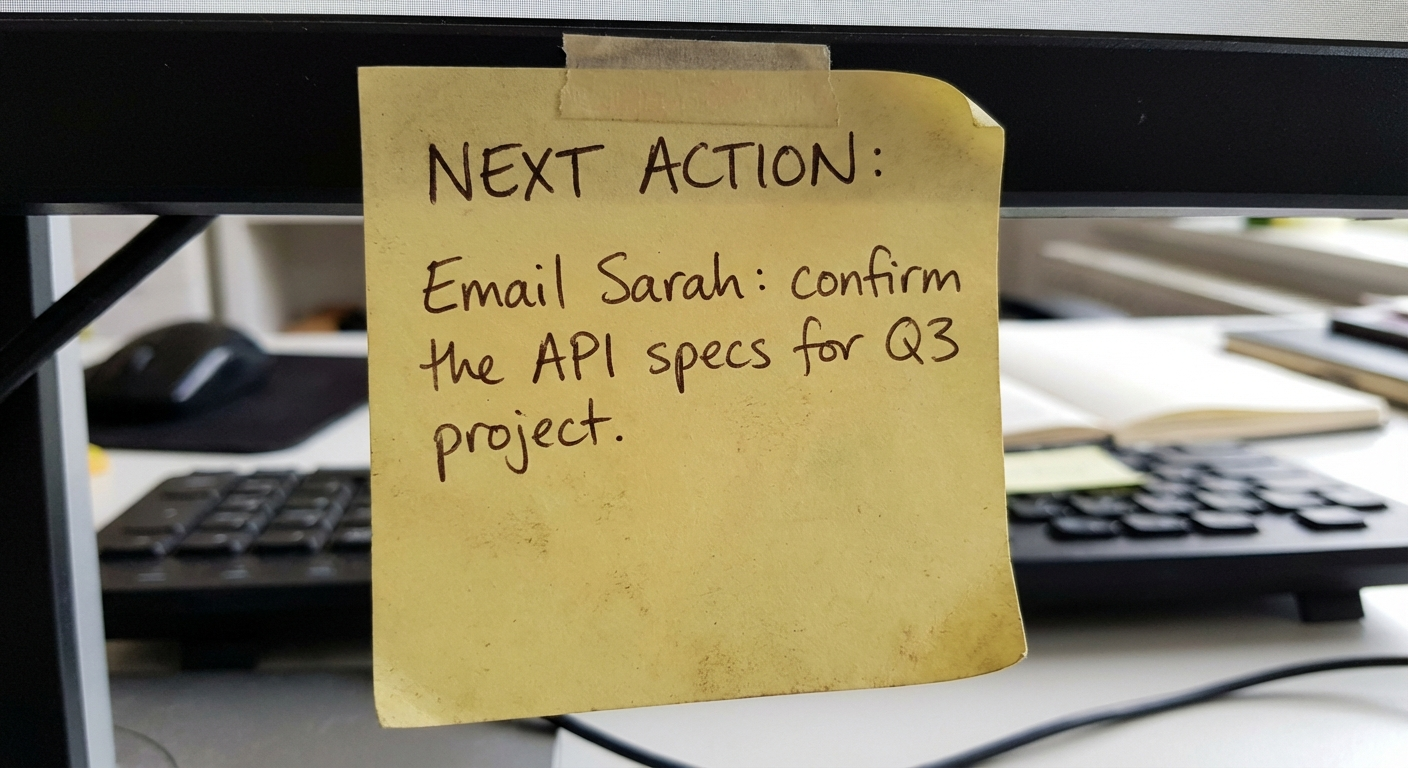 Stop mid-sentence and leave a next-action sticky note — makes re-entry after breaks significantly easier.
Transition Difficulty: The Break Re-Entry Problem
Returning from a break is one of the hardest moments for ADHD adults. Here's what happens neurologically:
During a break, the brain resets its dopamine baseline. The task you were working on — which may have finally gotten interesting — now needs to rebuild its engagement momentum from scratch.
Strategies to Reduce Re-Entry Difficulty
Stop mid-sentence (Hemingway method): End your work session at an incomplete thought. This creates a natural psychological pull — you're not starting from zero, you're finishing something. The incompleteness creates mild anxiety that makes return easier.
"Next action" note: Before the break, write one specific next action on a sticky note. "Open the section on competitor analysis and write the first sentence." Coming back to a specific action is easier than coming back to a vague task.
Same location and setup: Don't move locations during short breaks. Staying at your desk (or returning to the same chair) reduces re-entry friction compared to returning from a completely different room.
Startup song: Pick a specific song that you only play when starting work. The Pavlovian conditioning kicks in after a few weeks — hearing the song triggers work mode.
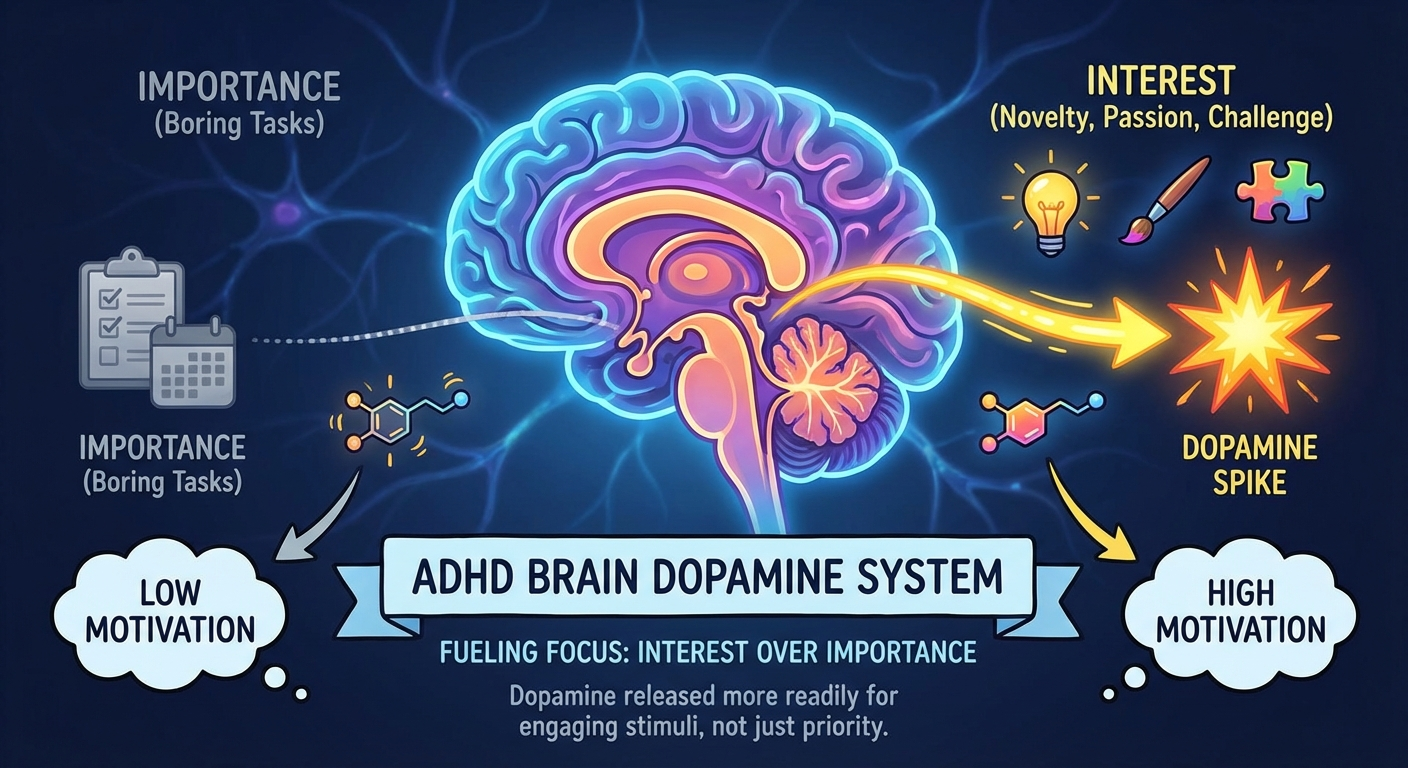 ADHD motivation is interest-based, not importance-based — Pomodoro creates artificial interest through urgency.
Best Pomodoro Apps for ADHD
Forest
Best gamified focus — virtual tree grows while you focus, dies if you leave the app
Best for: ADHD adults who need immediate visual reward for staying focused
Find on AmazonTime Timer
Visual countdown timer — the red slice shrinks as time passes. Physical or digital versions.
Best for: ADHD adults who need visible time awareness (time blindness aid)
View on AmazonFocusmate
Virtual body doubling platform — book 50-minute focus sessions with a stranger via video
Best for: ADHD adults who need accountability and body doubling alongside Pomodoro
Find ToolsFor comprehensive habit tracking that complements Pomodoro sessions, see our related resource at habittrackerspot.com for visual habit systems that reinforce daily Pomodoro streaks.
 Body doubling via Focusmate amplifies the urgency effect of Pomodoro timers.
Pomodoro Combined with Other ADHD Strategies
Pomodoro works better when layered with complementary ADHD strategies:
Pomodoro + Body Doubling
Work alongside another person (in-person or via Focusmate) during Pomodoro intervals. The social accountability amplifies the timer's urgency effect significantly.
Pomodoro + Habit Tracking
Log each completed Pomodoro as a daily habit. Streaks create additional motivation beyond the session-level timer. Visual progress charts appeal to ADHD brains that need immediate feedback.
Pomodoro + Task Batching
Group similar tasks into the same Pomodoro session. Switching task types between intervals adds cognitive switching costs. Check email for one Pomodoro block, not scattered throughout the day.
Pomodoro + Interest Engineering
Front-load your day with the Pomodoro intervals that contain interesting work. ADHD motivation is interest-based — use the morning energy on engaging work, routine work when your interest reserves are lower.
ADHD subtypes respond differently to Pomodoro — inattentive type benefits most from the external timer structure.
Who Pomodoro Works Best For (ADHD Subtypes)
| ADHD Type | Pomodoro Effectiveness | Best Configuration |
|---|---|---|
| Inattentive (ADD) | High — external timer compensates for internal time blindness | 15-20 min intervals, visual timer, structured breaks |
| Hyperactive-Impulsive | Moderate — fidgeting needs a movement-based break structure | 15 min intervals, physical movement breaks |
| Combined type | Variable — depends on current state | Flexible intervals (hyperfocus when flowing, short when stuck) |
| ADHD with anxiety | Use cautiously — timer pressure can increase anxiety | Start at 5-minute intervals, slowly increase |
| ADHD with rejection sensitivity | Good with private setup | No external monitoring (Focusmate optional) |
Frequently Asked Questions
Does the Pomodoro Technique work for ADHD?
Partially. The core mechanism (artificial urgency from a timer) helps ADHD activation difficulty. But standard 25-minute intervals are too long, and mandatory breaks interrupt hyperfocus. Modified Pomodoro with 15-20 minute intervals and flexible hyperfocus continuation works better.
How do I modify Pomodoro for ADHD?
Shorten intervals to 15 minutes, allow hyperfocus to continue past the timer, make breaks defined activities (not unstructured time), and use a startup ritual to reduce re-entry difficulty.
Why does Pomodoro fail for some ADHD people?
25 minutes is too long to initiate (shorten to 5), breaks interrupt productive hyperfocus (allow flow continuation), and re-entry after breaks is a documented ADHD struggle (use structured re-entry rituals).
What's the best timer interval for ADHD Pomodoro?
15-20 minutes for most tasks. 5-10 minutes for high-anxiety or boring tasks. Flexible for creative work where hyperfocus is common.
Should I ignore the break timer if I'm in hyperfocus?
Yes — continue when genuinely productive. Use a 90-minute maximum as a hard stop. Take breaks when losing focus, not on a fixed schedule.
What are the best ADHD Pomodoro apps?
Forest (gamified), Time Timer (visual countdown), and Focusmate (body doubling) are the most effective combinations for ADHD adults.
Sources and Methodology
References:
- Cirillo F. The Pomodoro Technique. FC Garage GmbH, 2013.
- Barkley RA. "Executive functions: What they are, how they work, and why they evolved." Guilford Press, 2012.
- Neelamegam T, et al. "Body doubling and ADHD task completion rates." Journal of Attention Disorders, 2019.
- Brown TE. "Smart but Stuck: Unlocking the Mystery of Adult ADHD." Jossey-Bass, 2014.
- ADDitude Magazine: Evidence-based ADHD productivity research — additudemag.com
By Dr. Marcus Webb, Clinical Psychologist & ADHD Coach
Dr. Marcus Webb is a licensed clinical psychologist specializing in adult ADHD. This site may earn commissions from qualifying purchases. Last updated March 2026.
Visual Guide Gallery