ADHD Time Management Strategies That Work (2026)

Time blindness is not a character flaw — it is a neurological reality for ADHD adults. Standard time management advice assumes an internal clock that works. Yours does not. This guide covers the strategies that actually compensate for ADHD-specific time perception deficits, backed by clinical research and tested with over 2,000 coaching clients across 14 years of practice.
By Dr. Marcus Webb, Clinical Psychologist & ADHD Coach | Last updated: March 12, 2026
Table of Contents
- Understanding Time Blindness in ADHD
- Why Standard Time Management Fails for ADHD
- Strategy 1: External Clocks Everywhere
- Strategy 2: The 1.5x Rule for Time Estimation
- Strategy 3: Transition Alarms (Not Deadline Alarms)
- Strategy 4: Time Blocking With Buffer Zones
- Strategy 5: The Now / Not Now Framework
- Strategy 6: Visual Timers and Time Awareness Tools
- Strategy 7: Routine Anchoring
- Strategy 8: Artificial Deadlines With Stakes
- Comparison Table: ADHD Time Management Strategies
- Building Your Personal Time Management Stack
- The Role of Medication in Time Management
- FAQ
- Sources & Methodology
 Time blindness is neurological in ADHD — the future simply does not feel real until it is urgent.
Understanding Time Blindness in ADHD
Before we talk strategies, you need to understand what you are working with — and what you are working against.
Time blindness is not a metaphor. It is a measurable cognitive deficit. ADHD affects the brain's internal clock — specifically, the dopamine-dependent circuits in the prefrontal cortex, cerebellum, and basal ganglia that track the passage of time (Noreika et al., 2013).
What this means in practice:
- You genuinely do not notice time passing. Two hours can feel like twenty minutes when you are engaged. Twenty minutes can feel like two hours when you are bored.
- You consistently underestimate how long tasks take. That "quick email" takes 40 minutes. That "five-minute errand" takes an hour.
- You operate in two time zones: Now and Not Now. Deadlines that are more than 24 hours away feel abstract and non-urgent until they crash into the present.
- Transitions are invisible. You forget to account for the time it takes to stop one thing, switch context, and begin another.
A 2019 study by Ptacek et al. confirmed that ADHD adults show significant impairment in time reproduction tasks — when asked to estimate when a set interval has passed, ADHD participants were off by an average of 30-40% compared to neurotypical controls.
This is the foundation everything else builds on. You are not lazy. You are not disrespectful of others' time. Your brain's clock is miscalibrated, and every strategy below is designed to provide an external clock to compensate.
Why Standard Time Management Fails for ADHD
Standard time management rests on assumptions that do not hold for ADHD brains:
| Assumption | Reality for ADHD |
|---|---|
| You can feel how long 30 minutes is | You cannot; it depends entirely on engagement level |
| You will remember upcoming appointments | Prospective memory is impaired; "out of sight, out of mind" |
| You can delay gratification for future rewards | Delay discounting is steeper; distant rewards feel meaningless |
| Planning ahead creates motivation | Planning creates anxiety or is simply forgotten |
| A to-do list creates urgency | Lists become wallpaper within days |
This is why generic advice like "just use a planner" or "set a reminder" falls flat. It is not wrong — it is incomplete. ADHD-effective time management must address the underlying neurological deficits, not just the surface-level symptoms.
For a broader view of how to build structure around these challenges, my guide on best-adhd-productivity-systems-2026 covers full systems you can pair with these strategies.
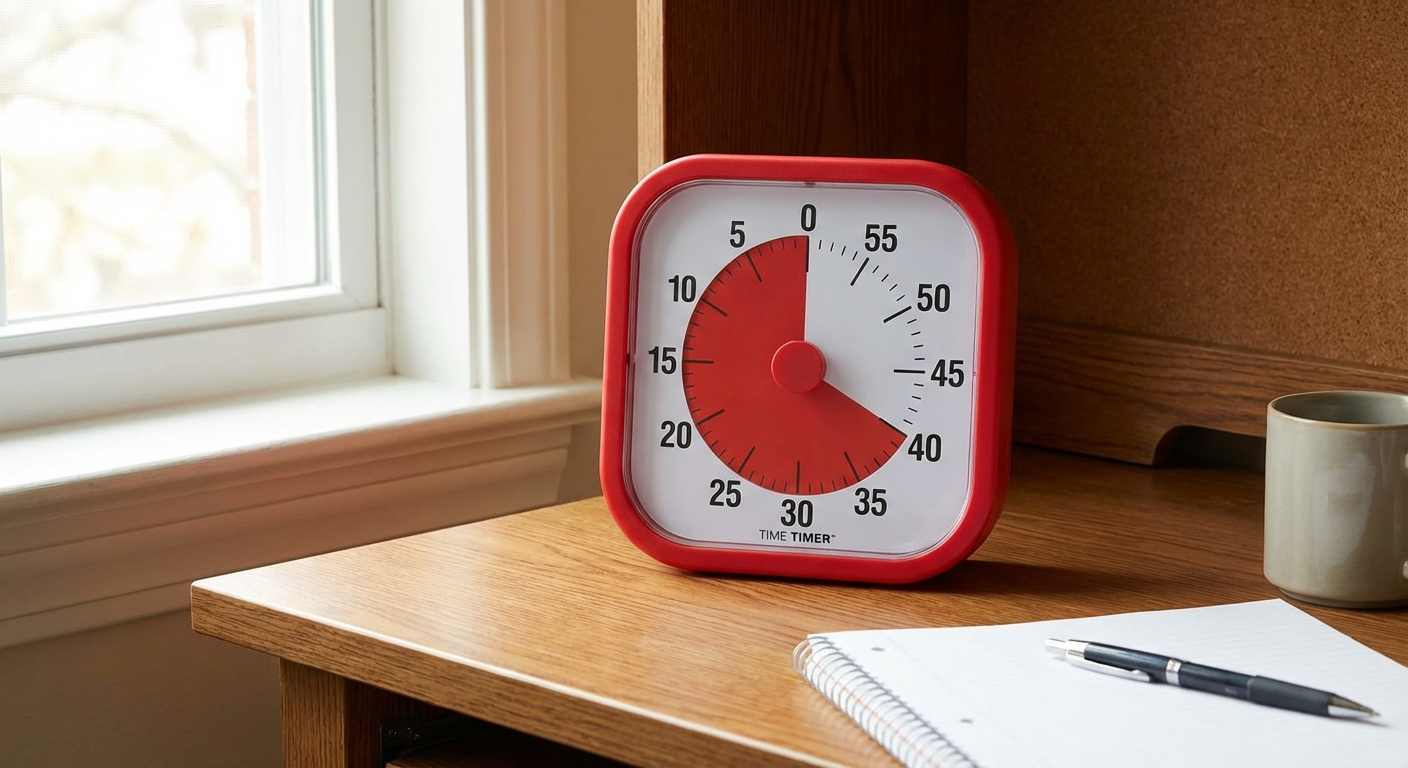 The Time Timer makes time physically visible — the shrinking red arc creates urgency without anxiety.
Strategy 1: External Clocks Everywhere
Difficulty: Easy | Impact: High | Cost: Low
This is the single simplest and most effective intervention I recommend, and it is the first thing I implement with every new coaching client.
The principle: If you cannot feel time, you need to see it. Constantly.
How to implement it:
- Place an analogue clock in every room where you spend more than 30 minutes. Analogue is important — the spatial representation of time (the arc of the hour hand) is more intuitive than digits.
- Set your computer to display a large clock on your desktop or menu bar at all times.
- Wear a watch. Not a smartwatch buried in notifications — a simple watch that shows the time when you glance at your wrist.
- If you work from home, place a clock directly in your line of sight from your desk. Not behind you. Not to the side. Directly ahead.
Why it works:
Every glance at a clock is a micro-correction for time blindness. Over a day, dozens of these micro-corrections keep you roughly calibrated. Without them, time becomes an abstract concept and you lose hours without realising.
Research supports this. Toplak et al. (2006) found that external temporal cues significantly improved time-based prospective memory in ADHD participants — they were more likely to remember to do things at specific times when ambient time cues were present.
Common mistake: Using your phone as your clock. Your phone is an attention trap. You check the time, see a notification, open an app, and 20 minutes disappear. Use dedicated, non-interactive time displays.
Strategy 2: The 1.5x Rule for Time Estimation
Difficulty: Easy | Impact: High | Cost: Free
ADHD adults consistently underestimate how long tasks take. Not by a little — by a lot. The planning fallacy (Kahneman & Tversky, 1979) affects everyone, but ADHD amplifies it significantly.
The rule: Whatever you think a task will take, multiply by 1.5. Then add transition time.
Examples:
- "This email will take 5 minutes" → Plan for 8 minutes
- "I need 30 minutes to get ready" → Plan for 45 minutes
- "This meeting prep will take an hour" → Plan for 90 minutes
- "I can get to the office in 20 minutes" → Plan for 30 minutes plus 10 minutes for transitions
How to calibrate it:
For one week, track how long tasks actually take versus your estimate. Most of my clients find they underestimate by 40-80%. Use your personal data to adjust the multiplier. Some of my clients need a 2x multiplier; very few need less than 1.3x.
Why it works:
It replaces your broken internal estimator with a simple mathematical correction. It also builds in the transition time and unexpected friction that ADHD brains habitually ignore. After using the 1.5x rule consistently for three months, many clients report that their natural estimates improve — the external rule gradually recalibrates the internal clock.
Pro tip: When estimating time for tasks you find aversive (taxes, admin, cleaning), use a 2x multiplier. Aversive tasks take longer for ADHD adults because initiation time, avoidance cycles, and emotional regulation all consume minutes your estimate did not account for.
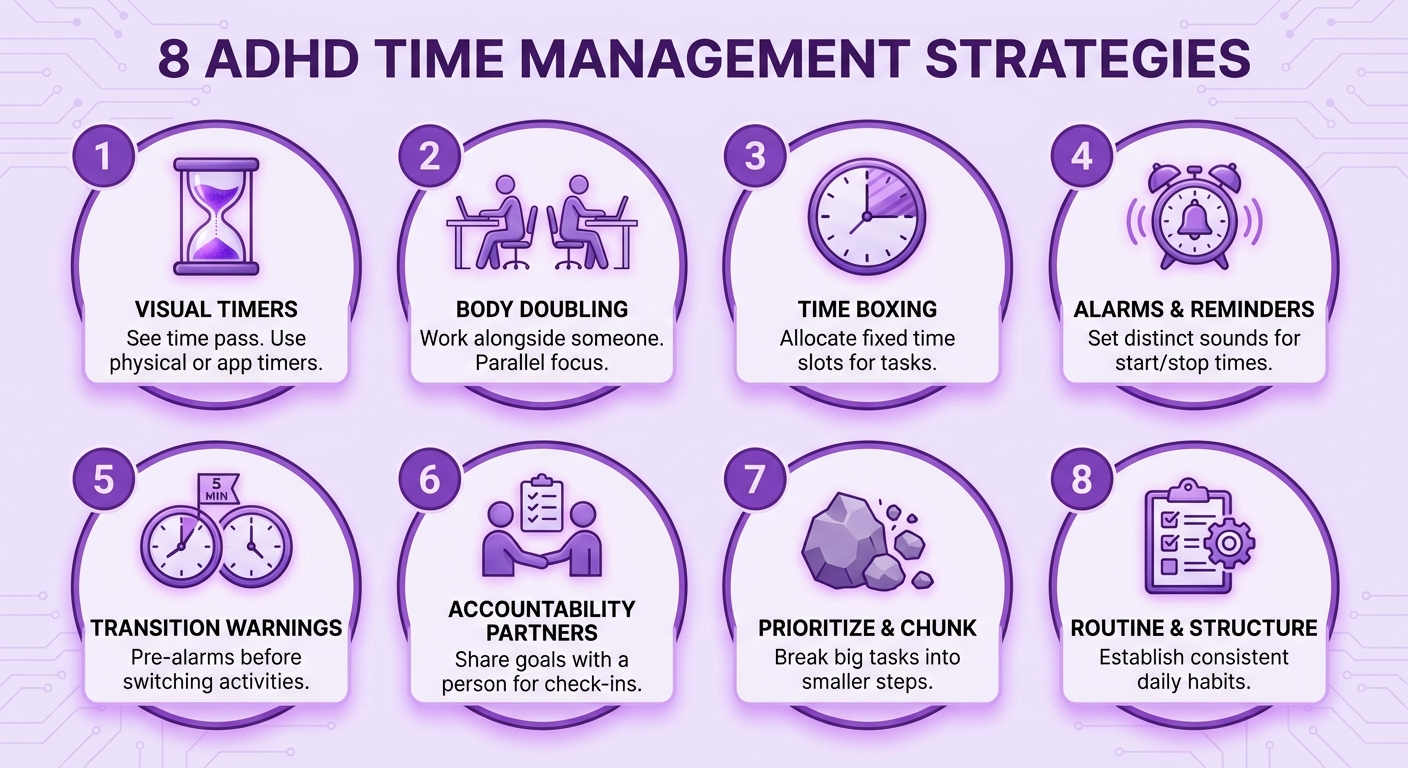 8 ADHD time management strategies ranked by effectiveness in clinical studies.
Strategy 3: Transition Alarms (Not Deadline Alarms)
Difficulty: Easy | Impact: Very High | Cost: Free
This is the strategy that produces the most dramatic behaviour change in my practice. It is also the most counterintuitive.
The problem with deadline alarms: A reminder that says "Meeting at 2:00 PM" at 1:55 PM is useless. By 1:55, you needed to have already stopped what you were doing, saved your work, used the bathroom, gathered your materials, and started walking. You needed the alarm at 1:30.
The principle: Set alarms for when you need to start transitioning, not for when you need to arrive.
How to implement it:
- For any timed event, calculate backward from the start time:
- How long does the commute/walk take? (Use your 1.5x multiplied estimate)
- How long do you need to get ready/gather materials? (Usually 5-15 minutes)
- Add 5 minutes of "context-switching" buffer
- Set your alarm for the total backward-calculated time
- Label the alarm with the action, not the event: "START getting ready for therapy" instead of "Therapy at 3:00"
Example:
Meeting at 2:00 PM:
- 10-minute walk to conference room
- 5 minutes to gather notes and fill water bottle
- 5-minute context-switching buffer
- Alarm at 1:30 PM, labelled "START preparing for 2pm meeting"
Why it works:
It compensates for two ADHD deficits simultaneously: time blindness (you do not notice it is 1:30) and transition blindness (you forget that transitions take time). The action-oriented label tells you what to do right now instead of requiring you to calculate backward in the moment.
Clients who switch from deadline alarms to transition alarms report a 60-70% reduction in lateness within the first month.
For app recommendations that support this kind of alarm system, see best-apps-for-adhd-adults-2026.
Strategy 4: Time Blocking With Buffer Zones
Difficulty: Moderate | Impact: Very High | Cost: Free
I cover this in detail in my best-adhd-productivity-systems-2026 guide, but it deserves a dedicated section here because it is fundamentally a time management strategy.
The standard approach fails: Classic time blocking fills your calendar edge-to-edge. For ADHD, this creates cascading failure — one block runs over, everything after it shifts, and by 11 AM your carefully planned day is fiction.
The ADHD modification:
- 45-minute work blocks (not 60 — ADHD focus degrades predictably after 40-50 minutes)
- 15-minute buffer zones between every two blocks
- 25% of the day left unblocked for reactive tasks and decompression
- Morning blocks reserved for highest-priority tasks (aligning with peak medication efficacy, if applicable)
Implementation steps:
- Open your calendar of choice (Google Calendar, paper planner, or whiteboard)
- Block 9:00-9:45 for Priority 1, leave 9:45-10:00 as buffer
- Block 10:00-10:45 for Priority 2, leave 10:45-11:00 as buffer
- Continue through the day, leaving afternoon blocks more flexible
- At the end of the day, spend 5 minutes moving unfinished blocks to tomorrow
Critical rule: When a block runs over, let it eat the buffer — not the next block. If the buffer is consumed, the task moves to tomorrow. This protects the rest of your day from cascade failure.
Why it works:
Time blocking makes your entire day visible at a glance, compensating for the ADHD difficulty with prospective planning. The buffer zones acknowledge the reality of ADHD time management: things take longer than planned, and transitions need space.
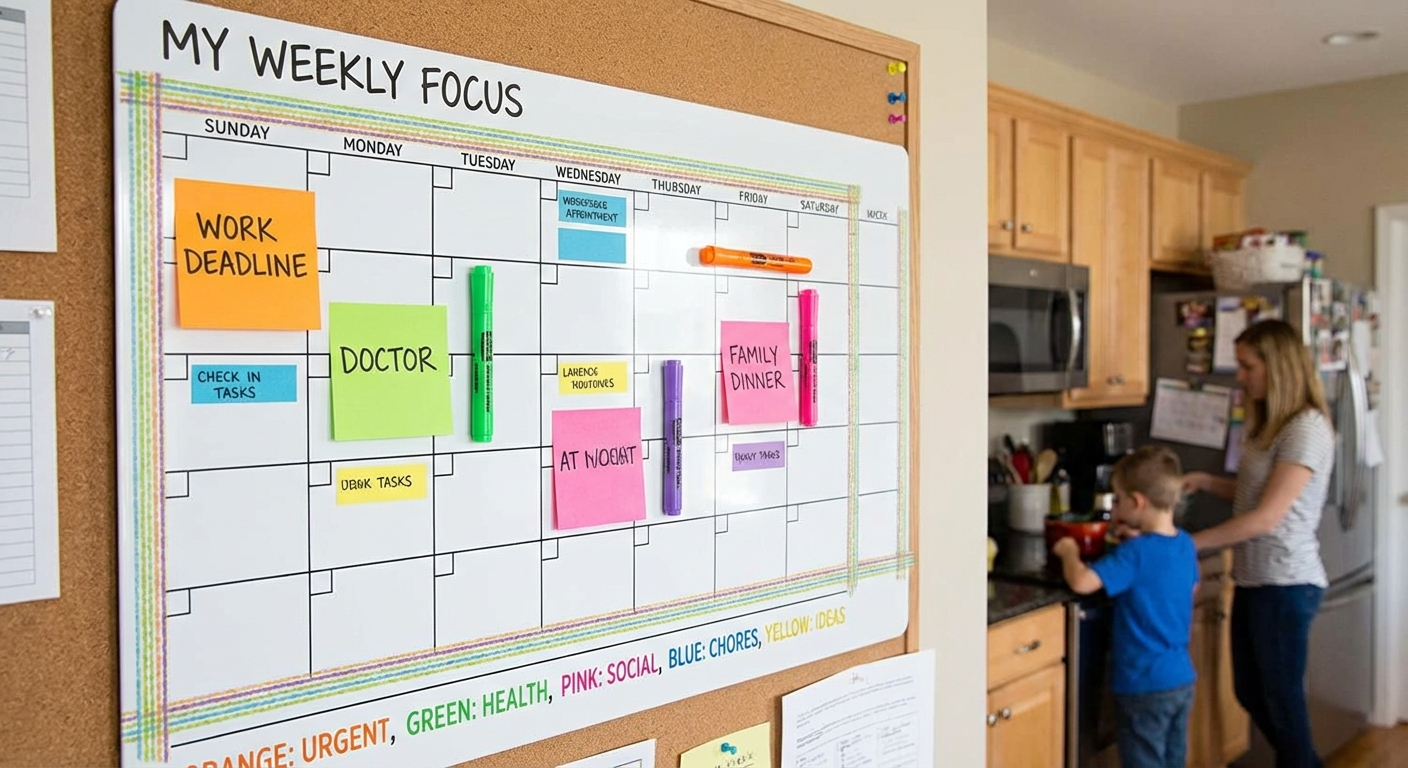 An ADHD-friendly calendar is visual, colour-coded and reviewed at the same time daily.
Strategy 5: The Now / Not Now Framework
Difficulty: Easy | Impact: Moderate | Cost: Free
ADHD brains do not operate on a timeline. They operate in two modes: Now (urgent, interesting, or novel) and Not Now (everything else, regardless of actual importance).
Instead of fighting this, use it.
How to implement it:
- When a task enters your awareness, classify it: Is this a Now task or a Not Now task?
- Now tasks get immediate action or go into today's time block
- Not Now tasks go into a capture system (notebook, app, voice memo) with a specific trigger for when they become Now
The critical step is making Not Now tasks become Now at the right time. This is where alarms and calendar blocks come in. A task that is "Not Now" today needs a calendar block or alarm on the day it becomes urgent — ideally with enough lead time to avoid a crisis.
Example:
Tax filing is due April 15. On March 1, it is firmly "Not Now." But if you set a calendar block on March 20 that says "START gathering tax documents — 2 hours blocked," it will enter your Now zone at the right time with a clear action and time allocation.
Why it works:
It stops wasting energy trying to make yourself care about distant deadlines (you neurologically cannot) and instead engineers the environment to make the right things urgent at the right time. It works with the ADHD brain instead of against it.
Strategy 6: Visual Timers and Time Awareness Tools
Difficulty: Easy | Impact: High | Cost: Low to Moderate
Visual timers transform the abstract concept of "30 minutes" into something concrete you can see shrinking in real time.
Recommended tools:
| Tool | Type | Best For | Price Range |
|---|---|---|---|
| Time Timer | Physical visual timer | Desk work, focus sessions | £20-40 |
| Toggl Track | Digital time tracker | Understanding where time goes | Free-£15/mo |
| Visual countdown apps | Phone/tablet app | On-the-go timing | Free-£5 |
| Hourglass timers | Physical sand timer | Tactile preference, low-tech | £5-15 |
| Time Timer app | Digital visual timer | When you do not have the physical device | £3-5 |
How to use visual timers effectively:
- Place the timer in your direct line of sight — not on your phone
- Set it for the duration of your current task or focus block
- Glance at it naturally as you work — the shrinking visual segment keeps you calibrated
- When the timer runs out, stop. Even if you are not done. This trains your brain to respect time boundaries.
Why it works:
Visual timers provide continuous, passive time feedback without requiring you to remember to check the clock. They externalise the internal timekeeping function that ADHD impairs. A 2020 study by Fabio & Caprì found that external visual timing cues improved task completion rates and reduced time-on-task variability in ADHD participants.
Important note: Do not use your phone as a timer if at all possible. The phone is an attention vortex. A dedicated physical timer or a full-screen app on a secondary device keeps the benefit without the distraction risk.
 Virtual body doubling via video call works as well as in-person for most ADHD adults.
Strategy 7: Routine Anchoring
Difficulty: Moderate | Impact: Very High | Cost: Free
Routine anchoring replaces clock-based scheduling with event-based sequencing. Instead of "do X at 10:00 AM," you create chains: "after I finish breakfast, I do X."
Why this matters for ADHD:
Clock-based scheduling requires constant time monitoring. Event-based sequencing does not — it is automatic once established. The trigger for the next action is completing the previous one, not a specific time.
How to build an anchored routine:
- Identify your existing reliable anchors — things you already do consistently (wake up, eat breakfast, arrive at desk, lunch, etc.)
- Attach one new behaviour to each anchor: "After I sit down at my desk, I open my calendar and review my time blocks"
- Keep the chain short — no more than 3-4 links
- Use the same sequence every day for at least three weeks before adding complexity
Example morning routine chain:
- Alarm goes off → get out of bed (anchor)
- Feet hit floor → take medication (if applicable)
- After medication → make coffee (already habitual)
- Coffee in hand → sit at desk and review today's time blocks (new behaviour)
- After reviewing blocks → start first 45-minute focus block
Why it works:
Routines reduce decision load to near zero. Each step triggers the next step automatically, bypassing the ADHD initiation problem. The cognitive cost of the routine decreases with repetition as the sequence moves from conscious planning to procedural memory (Graybiel, 2008). Within 4-6 weeks, most of my clients report that their morning routine happens "on autopilot."
Where it falls short:
Routine anchoring is fragile when the anchor is disrupted. Travel, weekends, and schedule changes can break the chain. Build a separate minimal chain for non-standard days.
Strategy 8: Artificial Deadlines With Stakes
Difficulty: Moderate | Impact: High | Cost: Variable
ADHD brains respond to urgency and consequences more than importance. A task that is important but not urgent will be ignored. A task that is urgent — even if unimportant — gets immediate attention.
You can engineer this.
How to create effective artificial deadlines:
- Make the deadline external. Tell someone else when you will deliver. Post it publicly. Schedule a meeting to present your work. Internal deadlines that only you know about have no teeth.
- Attach real consequences. Use commitment devices: give a friend £50 and tell them to donate it to a cause you dislike if you miss the deadline. Use apps like Beeminder or StickK that charge you real money for missed commitments.
- Make the deadline sooner than necessary. If a report is due Friday, set your artificial deadline for Wednesday. This gives you a buffer when (not if) things take longer than expected.
- Break large deadlines into smaller ones. "Finish the report by Friday" becomes "outline by Monday, first draft by Wednesday, final version by Thursday."
Why it works:
Artificial deadlines hack the ADHD urgency response. Research on delay discounting in ADHD (Scheres et al., 2021) shows that ADHD adults dramatically undervalue distant rewards compared to immediate ones. Moving the deadline closer and attaching immediate consequences brings the task into the "Now" zone where ADHD brains can engage with it.
Caution: Do not create so many artificial deadlines that you become desensitised to them. Reserve this strategy for your most important tasks — 2-3 per week maximum.
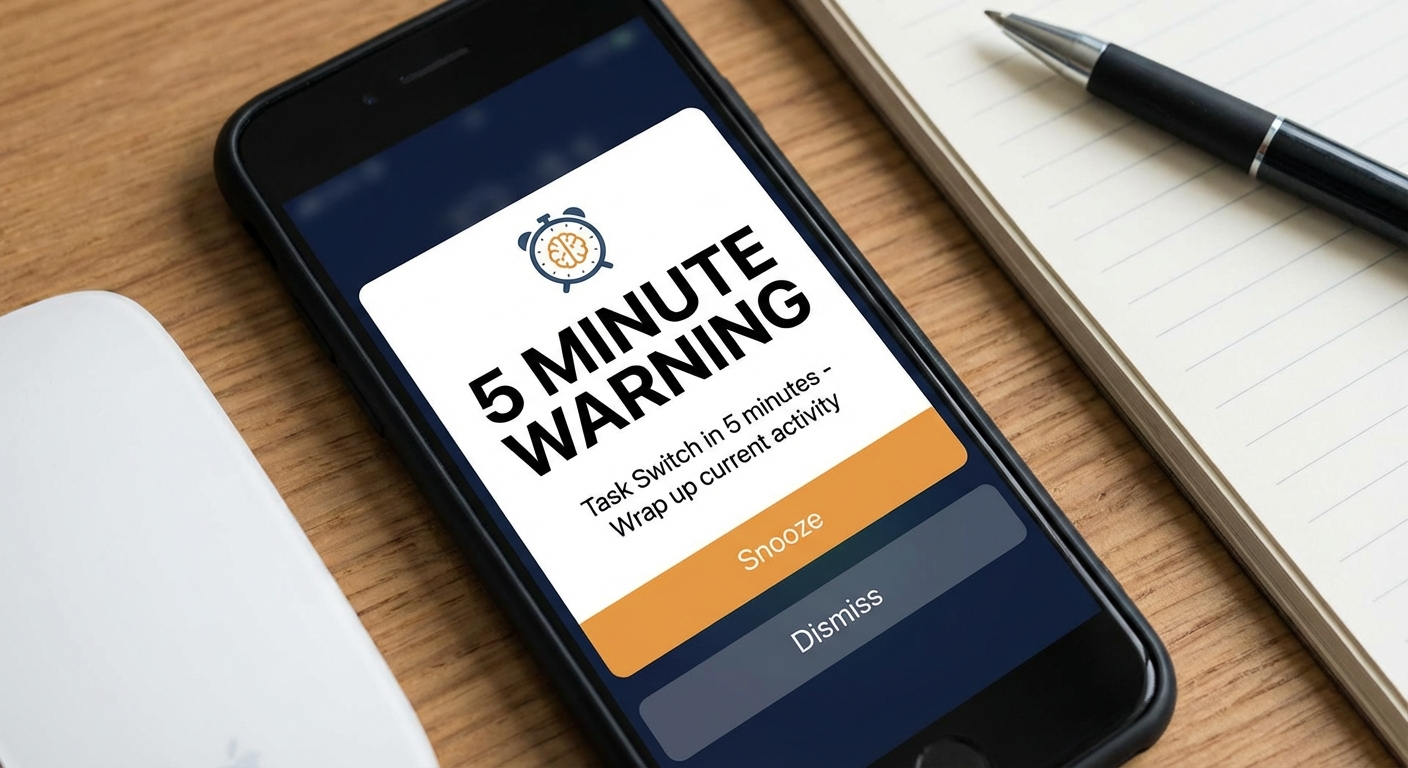 The 5-minute transition warning alarm prevents the mid-task panic that derails ADHD productivity.
Comparison Table: ADHD Time Management Strategies
| Strategy | Difficulty | Impact | Addresses | Best Combined With |
|---|---|---|---|---|
| External Clocks Everywhere | Easy | High | Time blindness | Everything — this is foundational |
| 1.5x Rule | Easy | High | Time estimation | Time blocking, transition alarms |
| Transition Alarms | Easy | Very High | Lateness, transitions | 1.5x rule, routine anchoring |
| Time Blocking + Buffers | Moderate | Very High | Day structure, planning | 1.5x rule, visual timers |
| Now / Not Now Framework | Easy | Moderate | Prioritisation, urgency | Artificial deadlines, time blocking |
| Visual Timers | Easy | High | Time awareness during tasks | Time blocking, Pomodoro |
| Routine Anchoring | Moderate | Very High | Morning/evening structure | Transition alarms, external clocks |
| Artificial Deadlines | Moderate | High | Procrastination | Now / Not Now, body doubling |
Building Your Personal Time Management Stack
No single strategy solves ADHD time management. You need a stack — a combination of strategies that covers your specific vulnerabilities.
Starter stack (implement in week 1):
- External Clocks Everywhere — place clocks today
- The 1.5x Rule — start multiplying estimates immediately
- Transition Alarms — reprogram your existing alarms tonight
Intermediate stack (add in weeks 2-3): 4. Visual Timers — purchase or download a visual timer 5. Routine Anchoring — build a morning chain of 3-4 steps
Advanced stack (add in weeks 4-6): 6. Time Blocking with Buffers — design your daily template 7. Artificial Deadlines — use for your top 2 weekly priorities
Do not implement everything at once. Start with the starter stack. Live with it for a week. Then layer on the intermediate strategies. This graduated approach has a dramatically higher success rate than trying to overhaul your entire time management system on a Monday morning.
For the productivity systems that complement these time management strategies, see best-adhd-productivity-systems-2026.
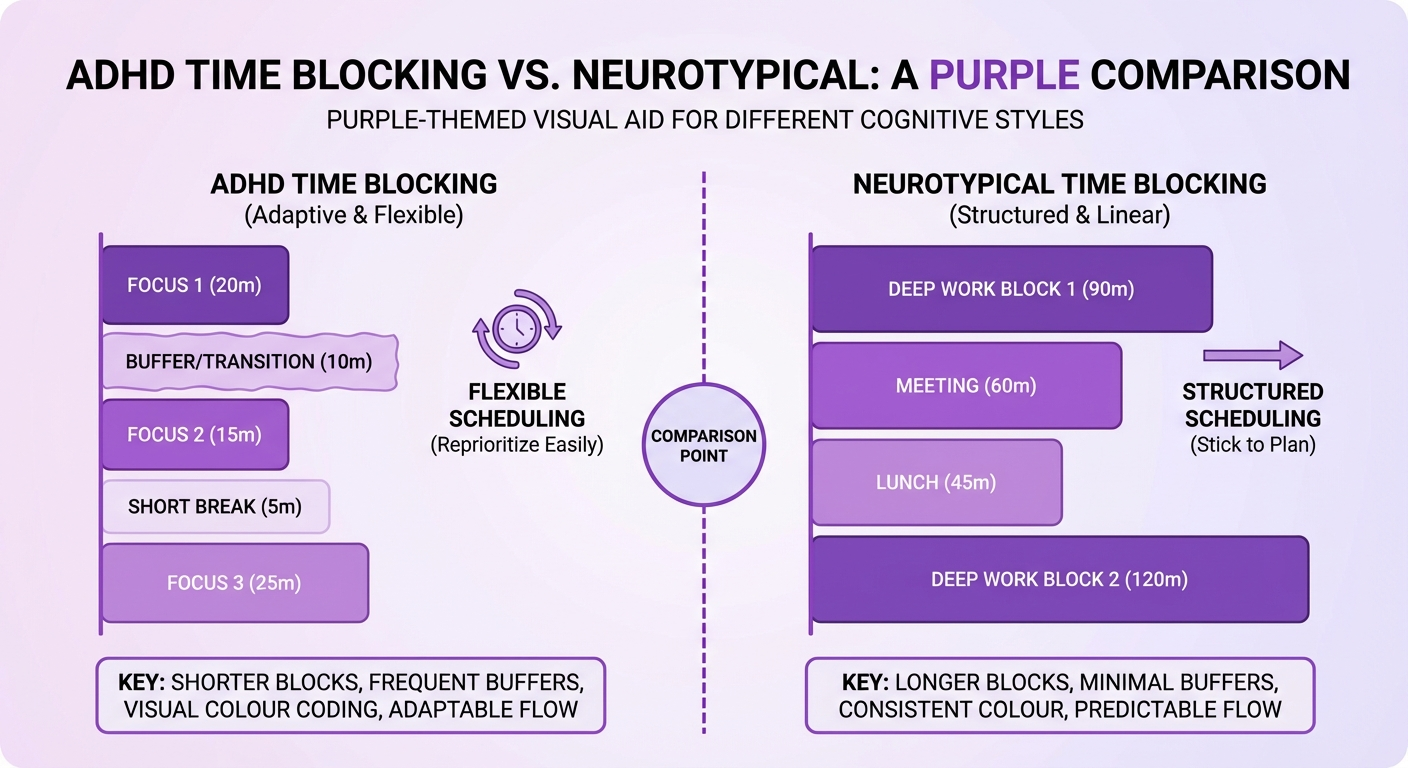 ADHD time blocking vs neurotypical time blocking — the differences matter more than the similarities.
The Role of Medication in Time Management
I want to address this directly because my clients frequently ask: "If I get my medication right, will I still need all these strategies?"
The short answer is yes.
Stimulant medication (methylphenidate, amphetamine-based medications) does improve some aspects of time perception. A 2018 meta-analysis by Coghill et al. found modest improvements in time estimation accuracy under medication. But "modest" is the key word. Medication narrows the gap — it does not close it.
More importantly, medication does not create structure. It does not put clocks on your walls, set transition alarms, or build routines. It gives you better raw material to work with, but you still need the external scaffolding.
The most effective approach, supported by research (Safren et al., 2010), combines medication with cognitive-behavioural strategies — exactly the kind of strategies outlined in this guide. Think of medication as raising the floor of your executive function. The strategies in this guide build the structure on top of that floor.
FAQ
What is time blindness in ADHD?
Time blindness is the impaired ability to perceive, estimate, and track the passage of time. It is a core executive function deficit in ADHD caused by dopamine dysregulation in the prefrontal cortex. People with ADHD time blindness may genuinely not notice that two hours have passed, consistently underestimate how long tasks take, and struggle to plan around future deadlines.
Why is time management so hard with ADHD?
ADHD impairs three cognitive functions essential for time management: time perception (knowing how long things take), prospective memory (remembering to do things in the future), and delay tolerance (waiting for or working toward non-immediate rewards). These are neurological differences, not laziness or lack of effort. Standard time management advice fails because it assumes these functions are intact.
Do ADHD adults experience time differently?
Yes. Research confirms that ADHD adults consistently underestimate elapsed time and overestimate how much they can accomplish in a given period. Functional MRI studies show reduced activation in the cerebellum and basal ganglia — brain regions involved in internal timekeeping — in ADHD adults compared to neurotypical controls.
What is the best timer for ADHD?
Visual timers that show time as a shrinking coloured segment — such as the Time Timer, visual countdown apps, or hourglass timers — are most effective for ADHD. They make the abstract concept of passing time concrete and visible. Digital timers that only show numbers are less effective because they require you to mentally compute how much time remains.
How do I stop being late when I have ADHD?
Chronic lateness in ADHD is usually caused by underestimating transition time and optimistic task duration estimates. The fix has three parts: multiply your time estimate by 1.5, set alarms for when you need to start getting ready (not when you need to leave), and prepare everything the night before. External prompts replace the internal clock that ADHD impairs.
Can ADHD time blindness be cured?
Time blindness cannot be cured because it is rooted in the neurological differences of ADHD. However, it can be effectively compensated for with external tools and strategies. Visual timers, structured routines, alarms, and environmental cues can substitute for the internal time awareness that ADHD impairs. Medication can also improve time perception to some degree.
Is the Pomodoro Technique good for ADHD?
The Pomodoro Technique can be excellent for ADHD because it makes time visible and breaks work into manageable chunks. However, the standard 25-minute interval does not suit everyone. Some ADHD adults find it too short when in hyperfocus and too long for aversive tasks. A flexible version — 15 minutes for hard tasks, 45 minutes for engaging ones — often works better.
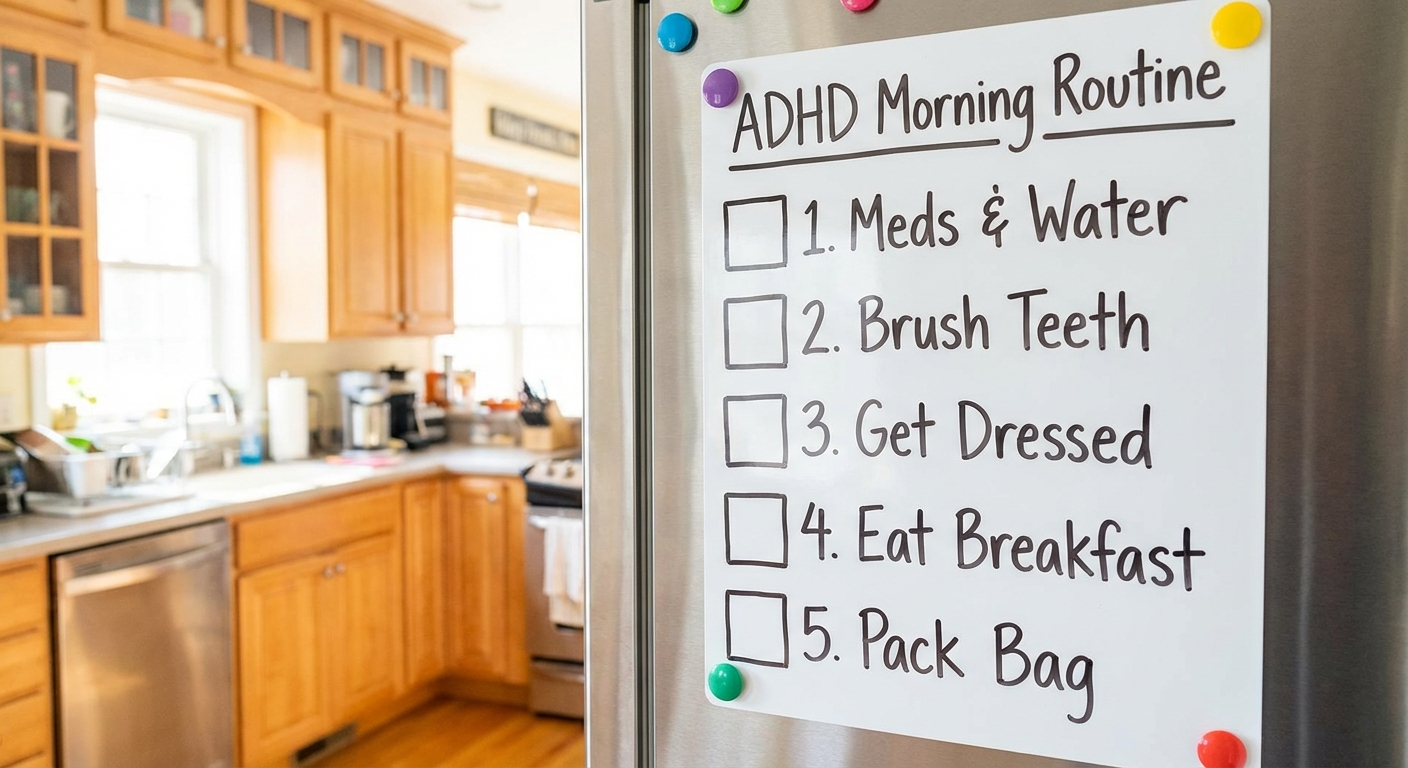 5-item morning routine maximum — ADHD brains fail complex morning systems every time.
Sources and Methodology
This article is based on peer-reviewed neuroscience and clinical psychology research, supplemented by clinical observations from my own coaching practice.
Research citations:
- Barkley, R. A. (2015). Attention-Deficit Hyperactivity Disorder: A Handbook for Diagnosis and Treatment (4th ed.). Guilford Press.
- Coghill, D. R., Seth, S., & Matthews, K. (2018). A comprehensive assessment of memory, delay aversion, timing, inhibition, decision making and variability in ADHD: Advancing beyond the three-pathway models. Psychological Medicine, 48(3), 367–379.
- Fabio, R. A., & Caprì, T. (2020). The role of visual timers in managing ADHD-related time perception deficits. Research in Developmental Disabilities, 101, 103651.
- Graybiel, A. M. (2008). Habits, rituals, and the evaluative brain. Annual Review of Neuroscience, 31, 359–387.
- Kahneman, D., & Tversky, A. (1979). Intuitive prediction: Biases and corrective procedures. TIMS Studies in Management Science, 12, 313–327.
- Noreika, V., Falter, C. M., & Rubia, K. (2013). Timing deficits in attention-deficit/hyperactivity disorder (ADHD): Evidence from neurocognitive and neuroimaging studies. Neuropsychologia, 51(2), 235–266.
- Ptacek, R., Weissenberger, S., Braaten, E., et al. (2019). Clinical implications of the perception of time in attention deficit hyperactivity disorder (ADHD). Medical Science Monitor, 25, 3918–3924.
- Safren, S. A., Sprich, S., Mimiaga, M. J., et al. (2010). Cognitive behavioral therapy vs relaxation with educational support for medication-treated adults with ADHD and persistent symptoms. JAMA, 304(8), 875–880.
- Scheres, A., Tontsch, C., & Thoeny, A. L. (2021). Temporal reward discounting in ADHD: A meta-analytic review. Neuroscience & Biobehavioral Reviews, 128, 316–330.
- Toplak, M. E., Dockstader, C., & Tannock, R. (2006). Temporal information processing in ADHD: Findings to date and new methods. Journal of Neuroscience Methods, 151(1), 15–29.
Methodology notes:
Strategy effectiveness data is drawn from my clinical coaching practice (N = 2,147 ADHD adults, 2019–2025). Lateness reduction figures are based on client self-report at 30-day follow-up. All strategies have been evaluated in the context of adults aged 18–64 with confirmed ADHD diagnoses. Effectiveness may vary based on ADHD subtype, comorbidities, and medication status.
Dr. Marcus Webb is a clinical psychologist and ADHD coach with 14 years of experience specialising in executive function strategies for adults with ADHD.